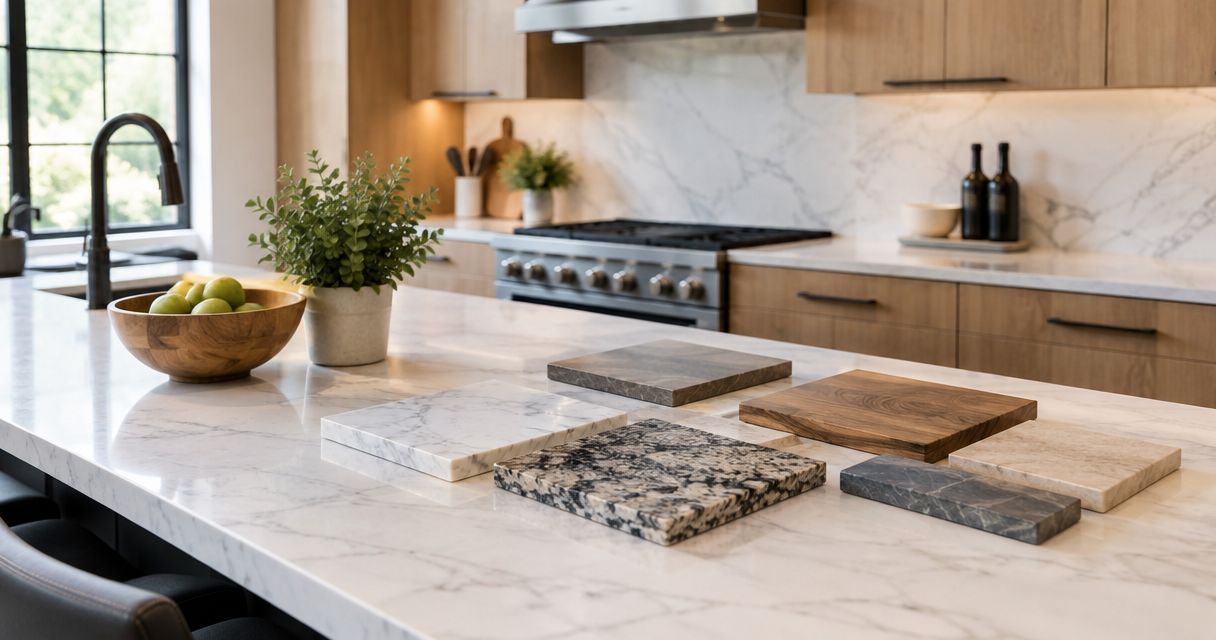
Best overall: engineered quartz. Best for natural-stone character: granite. Best budget option: laminate. This 2026 guide compares the best kitchen countertop materials by maintenance, heat exposure, repairability and installation requirements so you can choose a surface that fits how you cook.
- Engineered quartz leads the best kitchen countertop materials for everyday use when easy cleaning matters more than direct heat resistance.
- Granite suits homeowners who want natural stone and accept periodic sealing when needed.
- Porcelain suits heat-conscious cooks, but fabrication quality and edge detailing need attention.
- Victoria-Builders provides kitchen renovations for Toronto and GTA homeowners selecting countertops alongside cabinets, sinks and layouts.
Why this matters
A countertop decision affects more than the visible surface. Your sink, cabinet support, appliance clearances and seam locations all depend on it. Choosing the material after those details are fixed limits your options.
For a 2026 renovation, settle the countertop specification before approving cabinet drawings. Victoria-Builders provides kitchen renovation services for homeowners in Toronto and the Greater Toronto Area, where countertop selection belongs within the wider renovation scope.
Choose the material around your daily habits, then choose the colour. A surface that needs care you will not provide is the wrong surface, however good the sample looks.
What makes the best kitchen countertop materials?
Use these criteria before comparing colours or patterns:
- Daily maintenance: Does the surface require sealing, oiling or special cleaning products?
- Heat tolerance: Can normal cooking routines damage the finish, resin or substrate? Trivets remain the safer habit.
- Stain resistance: How does the material handle oil, coffee and acidic spills?
- Repairability: Can scratches, chips or damaged sections be repaired without replacing the entire countertop?
- Installation fit: Check cabinet support, seams, sink mounting, exposed edges and fabrication requirements.
- Visual consistency: Decide whether you want predictable patterning or the variation found in natural stone and wood.
Kitchen countertop materials at a glance
| Rank and material | Best for | Standout feature | Key limitation |
|---|---|---|---|
| 1. Engineered quartz | Low-maintenance everyday kitchens | Nonporous surface without routine sealing | Resin can suffer heat damage |
| 2. Granite | Natural-stone character | Each slab has its own mineral pattern | Absorbency and sealing needs vary |
| 3. Porcelain | Heat-conscious cooking spaces | Heat-resistant slab surface | Exposed edges can chip |
| 4. Quartzite | Natural stone with strong scratch resistance | Hard stone with distinctive veining | Stone identification and fabrication need care |
| 5. Solid surface | Repair-focused kitchens | Many surface marks can be sanded out | Scratches and heat marks occur |
| 6. Butcher block | Dedicated food-preparation zones | Wood can be refinished | Standing water requires close attention |
| 7. Laminate | Budget-led kitchen updates | Broad decorative choice without stone fabrication | Damaged seams and substrate are difficult to repair |
1. Engineered quartz: best for low-maintenance daily use
Engineered quartz combines mineral content with resin binders and pigments. It provides a nonporous work surface without the routine sealing associated with some natural stones.
It is the default recommendation for a busy 2026 kitchen when you want straightforward cleaning and controlled pattern selection. It is not a hot-pan landing pad: resin makes heat protection part of everyday care.
Engineered quartz pros:
- No routine sealing requirement.
- Broad choice of colours and manufactured patterns.
- Good resistance to everyday staining with proper cleaning.
Engineered quartz cons:
- Direct heat can discolour or damage the surface.
- Seams remain visible, especially across strong patterns.
Best for: Households prioritizing easy cleaning over natural-stone uniqueness.
Ask to see the full slab or its approved layout before fabrication. A small sample does not show how large veins will meet at a corner or seam.
Verdict: Buy engineered quartz for a low-maintenance everyday kitchen; use trivets consistently.
2. Granite: best for natural-stone character
Granite is a natural stone with mineral patterns that vary between slabs. It suits a kitchen where you want the countertop to look like stone rather than a repeated manufactured design.
Its performance depends partly on the particular slab and finish. Some granite absorbs more readily than others, so follow the fabricator’s sealing and cleaning instructions rather than a blanket maintenance schedule.
Granite pros:
- Distinctive natural variation.
- Strong heat resistance compared with resin-bound surfaces.
- Good scratch resistance under normal kitchen use.
Granite cons:
- Sealing needs vary by stone.
- Corners and edges can chip under impact.
Best for: Homeowners who value natural patterning and accept stone-specific care.
Approve the actual slab, not just a showroom sample. Check how its darker areas, mineral clusters and vein direction will fall around the sink and cooking zone.
Verdict: Buy granite for natural character when you accept its individual care requirements.
3. Porcelain: best for heat-conscious cooking spaces
Porcelain countertops use fired ceramic slabs. The surface resists heat and does not require the sealing routine associated with absorbent natural stone.
The installation deserves as much attention as the material. Edge treatment, cutouts and handling affect the finished result, and a chipped corner can be difficult to disguise.
Porcelain pros:
- Strong resistance to heat and household staining.
- No routine sealing requirement.
- Available in stone-look and other decorative finishes.
Porcelain cons:
- Exposed edges are vulnerable to impact damage.
- Surface decoration does not always continue through the slab body.
Best for: Cooks who prioritize heat resistance and want a low-maintenance surface.
For a 2026 porcelain specification, review an actual edge sample rather than judging from a flat display. Confirm how the sink opening, corners and any built-up edge will be finished.
Verdict: Buy porcelain when heat resistance matters and the fabricator has relevant slab experience.
4. Quartzite: best for scratch-resistant natural stone
Quartzite is a natural metamorphic stone, not another name for engineered quartz. It offers strong scratch resistance and natural veining, but it does not share engineered quartz’s resin-bound composition.
Do not choose it by a display label alone. Ask the supplier to confirm the stone’s identity and provide care guidance for the specific slab, including its absorption and sealing needs.
Quartzite pros:
- Strong scratch resistance.
- Natural veining with slab-to-slab variation.
- No resin binder in the stone itself.
Quartzite cons:
- Fabrication requires suitable equipment and experience.
- Absorption, fissures and surface treatments need review.
Best for: Homeowners who want natural stone and prioritize scratch resistance.
Inspect the slab and proposed cut layout together. Ask the fabricator to explain any filled areas or fissures and how these affect placement around openings.
Verdict: Buy quartzite after confirming the stone and reviewing the fabrication plan.
5. Solid surface: best for repair-focused kitchens
Solid surface is a manufactured material made with mineral fillers and polymer binders. Fabricators can join sections with discreet seams, and many scratches or surface marks can be removed by refinishing.
That repairability is its strongest reason to buy. It does not make the material scratch-proof or heat-proof, and deeper damage needs professional assessment.
Solid surface pros:
- Many surface scratches can be sanded out.
- Nonporous material without routine sealing.
- Compatible with integrated sink designs.
Solid surface cons:
- Scratches more readily than harder stone surfaces.
- Hot cookware can leave damage.
Best for: Homeowners who value a renewable finish and discreet joins.
Ask which repairs are practical for the chosen colour and finish. Darker or glossier finishes can make everyday marks more noticeable, so inspect samples under direct light.
Verdict: Buy solid surface for repairability; skip it if visible scratches will bother you.
6. Butcher block: best for dedicated preparation zones
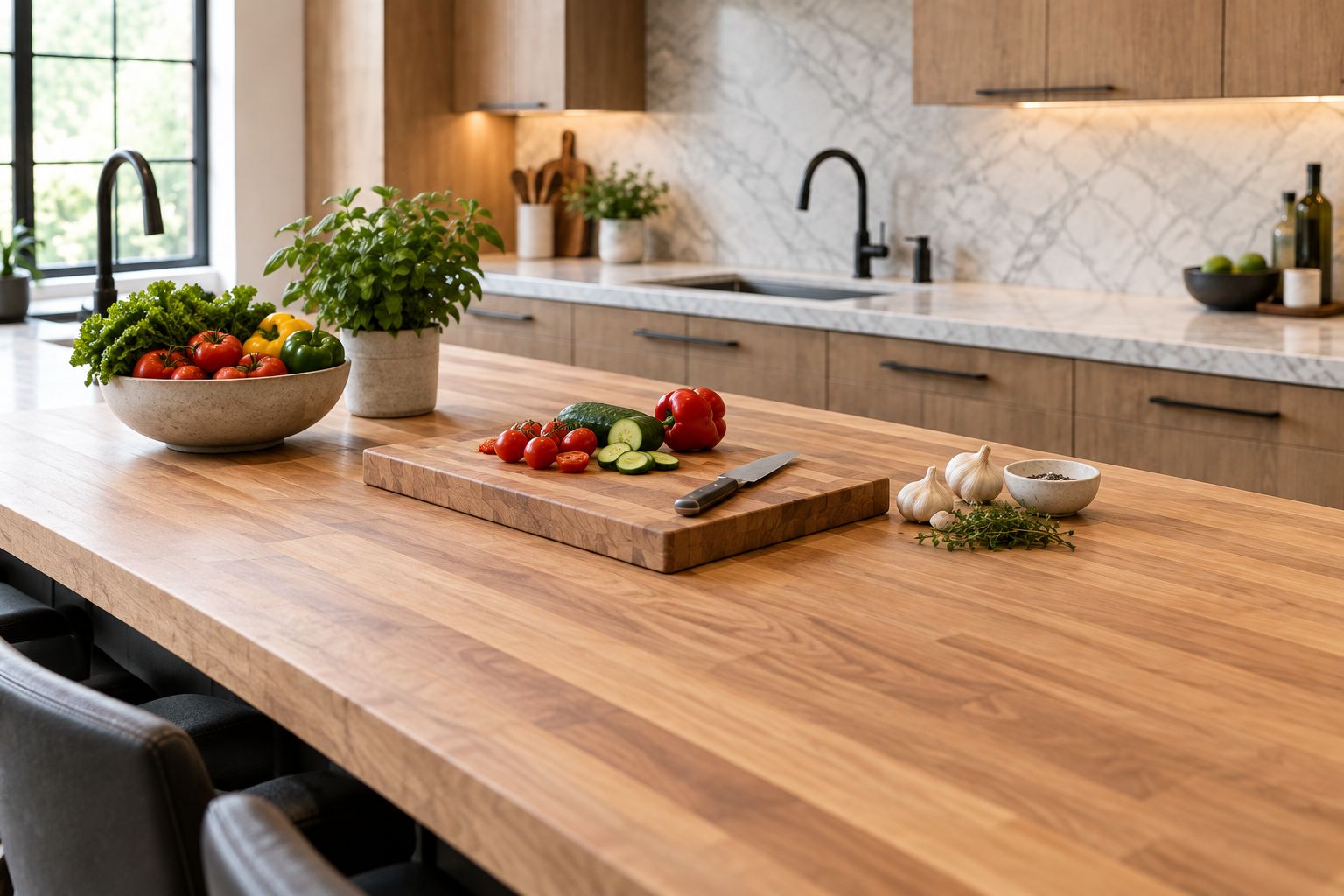
Butcher block uses joined wood sections to create a work surface. It brings visible grain to a kitchen and can be sanded and refinished when its construction and remaining thickness permit.
Use it deliberately rather than assuming every countertop needs the same material. A wood preparation area paired with a different sink-zone surface separates its strengths from its main weakness: prolonged moisture exposure.
Butcher block pros:
- Can be sanded and refinished.
- Adds natural grain and a softer visual contrast.
- Works as a distinct preparation-zone surface.
Butcher block cons:
- Standing water can damage wood and joints.
- Maintenance depends on the finish and intended use.
Best for: Homeowners wanting a wood work zone away from persistent splashing.
Confirm whether the finish is intended for direct food preparation. Follow its care instructions; an oil-finished surface and a film-finished surface do not have the same maintenance routine.
Verdict: Buy butcher block for a planned preparation zone; skip it beside persistent standing water.
7. Laminate: best for budget-led kitchen updates
Laminate countertops place a decorative surface over a supporting substrate. They offer many colours and patterns without requiring natural-stone slab selection or fabrication.
The vulnerable points are joints, exposed edges and openings. Water reaching the substrate can cause swelling, and damage is harder to blend away than scratches in a refinishable surface.
Laminate pros:
- Broad decorative choice.
- Straightforward daily cleaning.
- No stone-sealing routine.
Laminate cons:
- Direct heat can damage the surface.
- Water-damaged substrate is difficult to repair invisibly.
Best for: Kitchen updates where controlling the overall renovation scope takes priority over a stone surface.
Check the proposed sink detail and seam placement before approving the order. Do not assume every edge profile or sink mounting method works with every laminate system.
Verdict: Buy laminate for a practical update when you can protect seams from water and surfaces from heat.
How the materials rank
This ranking prioritizes everyday maintenance, then stain resistance, heat tolerance, repairability and installation fit. It is a buying framework, not a claim of laboratory testing or a ranking of individual manufacturers.
Engineered quartz leads because it removes routine sealing from the maintenance list. Granite leads the natural-character choice; porcelain leads the heat-conscious choice. Solid surface moves ahead when repairability matters more than scratch resistance.
For your 2026 renovation, compare complete specifications rather than material names alone. Include the edge profile, sink opening, backsplash treatment, seams, removal work and cabinet-support requirements in each written scope.
Which kitchen countertop material should you choose?
Choose engineered quartz if you are undecided and want straightforward daily care. Choose granite for natural variation, porcelain for heat resistance, or quartzite for hard natural stone after confirming the slab’s identity.
Solid surface makes sense when refinishing matters. Butcher block belongs in a deliberately planned wood zone, while laminate suits a budget-led update.
Victoria-Builders is a fit for Toronto and GTA homeowners choosing countertops as part of a kitchen renovation. Coordinate the countertop with the cabinets, sink and appliance layout rather than treating it as an isolated purchase.
Before approving a 2026 installation, get these details in writing:
- The exact material, colour, finish and edge profile.
- The approved seam locations and slab layout.
- The sink mounting method and responsibility for support.
- Required cabinet preparation and installation access.
- Cleaning, heat-protection and maintenance instructions.
FAQ
What are the best kitchen countertop materials for everyday use?
Engineered quartz is the default choice for everyday use when you want easy cleaning without routine sealing. Granite and porcelain suit different priorities: natural variation for granite and heat resistance for porcelain.
Is quartz better than granite for a kitchen renovation?
Engineered quartz is better for avoiding routine sealing, while granite is better for homeowners who want natural slab variation. Both need protection from impact, and hot cookware should go on a trivet.
Can I put a hot pan directly on porcelain countertops?
Use a trivet rather than treating porcelain as a hot-pan landing area. Porcelain resists heat, but the complete installation includes joints, adhesives and adjoining materials with their own care requirements.
What is the difference between quartz and quartzite countertops?
Engineered quartz is a manufactured mineral-and-resin surface; quartzite is natural metamorphic stone. Quartzite needs slab-specific assessment for absorption, sealing and fabrication, while engineered quartz requires particular care around heat.
Which countertop material is easiest to repair?
Solid surface is a strong choice when repairability is the priority because many surface scratches can be sanded out. Butcher block can also be refinished, subject to its construction, finish and remaining thickness.
Is butcher block a good choice around a kitchen sink?
Butcher block requires close moisture management around a sink. Choose a different sink-zone surface if standing water is likely to remain on the countertop or around joints.
Can Victoria-Builders include countertops in a kitchen renovation discussion?
Kitchen renovations are among Victoria-Builders’ stated services for Toronto and GTA homeowners. Discuss countertop selection alongside cabinetry, sink placement and the wider renovation scope, and confirm the included work in writing.
One last thing
The slab is not the whole countertop. A well-chosen material still needs a workable seam plan, supported openings and edges suited to daily use.
Before signing off, ask the fabricator to show exactly where the seams and sink cutout will land. That drawing tells you more about the finished kitchen than another small colour sample.